Native iOS and watchOS app, 2026
Tennis Time
The tennis scorer that lives on your wrist
A native scorekeeper for Apple Watch and iPhone. It knows the rules, tracks the match as a workout, lets friends follow live, and can be scored without touching the screen.
- 5.5
- weeks from first commit to iPhone and Watch 1.1
- 9
- languages, with full right-to-left support
- 109
- design-system components, 273 previews
- 1,350
- automated test cases
- 0
- third-party dependencies
Problem
Was that 30-15 or 15-30?
Every recreational match has the same argument. Nobody is umpiring, so the score lives in four tired heads. Phones stay in the bag, and stopping to tap a screen breaks the rhythm of play.
The players this is for already wear an Apple Watch. They play doubles with the same group every week, and they want to know who is actually improving. The job was to keep score without stopping play, and to turn those matches into something worth looking at afterwards.
- Users
- Club and recreational players, regular doubles groups
- Job to be done
- Keep an accurate score without interrupting play
- Constraint
- No account, no analytics, no third-party code
Research
Eleven competitors, and a niche nobody owned
Before any design, I compared eleven tennis scoring apps on rating, standalone watch support, doubles, heart rate, sync, gestures, formats, trial and price. No single app was strong across the board.
The one-star reviews repeated two complaints: scores lost in the middle of a match, and a scoreboard locked behind a paywall. Both became product rules. The match is saved after every single point, and the scoreboard itself is never gated.
It also shaped pricing. The ten-day trial starts when the first match is finished, not at install, so nobody pays before they have seen what the app does on a court.
Scoring engine
Try the scoring engine
The score is never stored. It is recomputed from the list of points, which is why undo is always exact and a crash can never corrupt a match. Tap a card to score a point.
Event log
- Games
- 0-0
- events.count
- 0
Undo removes the last event and the whole match is recomputed. There is no score to get out of sync.
Decisions
Five decisions that shaped the product
Scoring without touching the watch
- Problem
- Apple offers one hands-free gesture, Double Tap, and it fails when the wrist hangs down between points.
- Decision
- Build a wrist-gesture detector on raw motion data, and tune it on recordings of real matches instead of guesses.
- Outcome
- Three matches recorded at 100 Hz, 77.5 minutes in total. The first detector fired 140 false gestures. After adding a rule that a gesture must start from a still wrist, it fired none, and still recognised 62 of 62 lab takes.
A rating built on points, not wins
- Problem
- In a regular doubles group, win and loss says little. Partners rotate and a 7-6 loss to the strongest pair is a good day.
- Decision
- An Elo-style rating driven by the share of points each side won, weighted by match length. Partners split the change.
- Outcome
- A close loss can raise a rating and a sloppy win can lower it, which matches how players judge their own day.
The iPhone app exists because of a billing rule
- Problem
- Version 1.0 shipped as a watch-only app. App Store Connect then refused to attach a subscription to an app with no iPhone counterpart.
- Decision
- Bring the iPhone app forward to 1.1 and make it worth having: full scoring without a watch, statistics, history and live follow.
- Outcome
- The business model was unblocked, and friends without a watch became users.
A court test that reset the goals
- Problem
- With four people on a court, a friend's watch showed points 5 to 18 seconds late, then 26 queued points arrived at once.
- Decision
- The logs showed the following watch was asleep, because it had no workout running. Followers now run their own workout session.
- Outcome
- Live follow became a feature people could trust, and each follower gets their own health data from the match.
A full audit before submission
- Problem
- A rejected build costs days, and a billing bug after launch costs trust.
- Decision
- Run five parallel reviews before the first submission: security, tests, design system, architecture and App Store guidelines.
- Outcome
- Fourteen blockers were found and fixed before Apple saw the app, including paying users treated as free after a relaunch.
Hands-free
Four ways to score without tapping
Every input has its own undo, performed within two seconds. All of them are off by default and can be enabled one by one.
| Input | My point | Their point | Undo |
|---|---|---|---|
| Double Tap | Double Tap | Not available | Double Tap again |
| Digital Crown | Turn up | Turn down | Opposite turn |
| Swipe | Swipe up | Swipe down | Opposite swipe |
| Wrist gestures | Two snaps down | Two snaps up | Two wrist rolls |
Watch
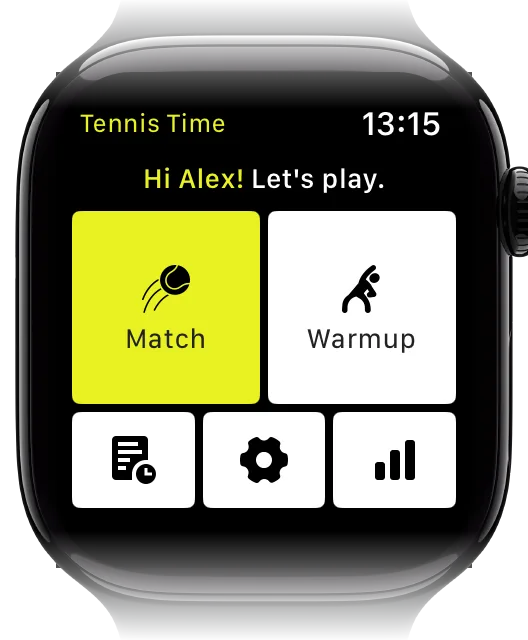
The watch does the umpiring
Three looping pages during a match: sets, score and controls. A drawn court shows who serves to whom after every point.
Home 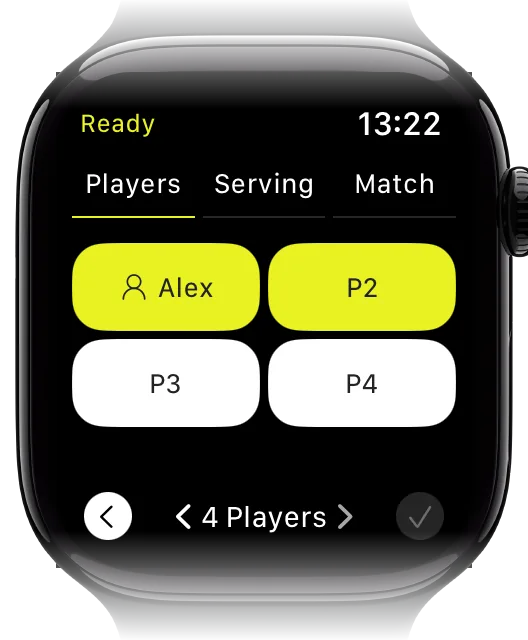
Line-up 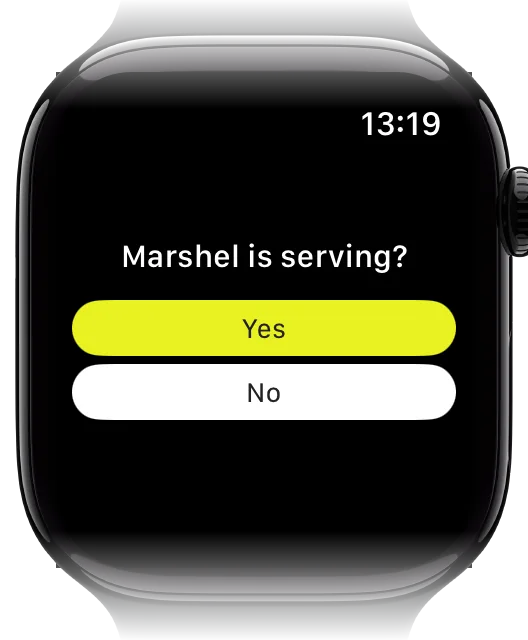
Who serves 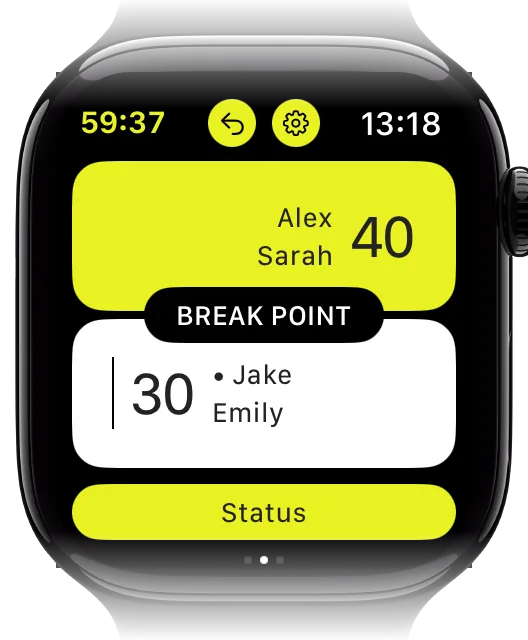
Break point 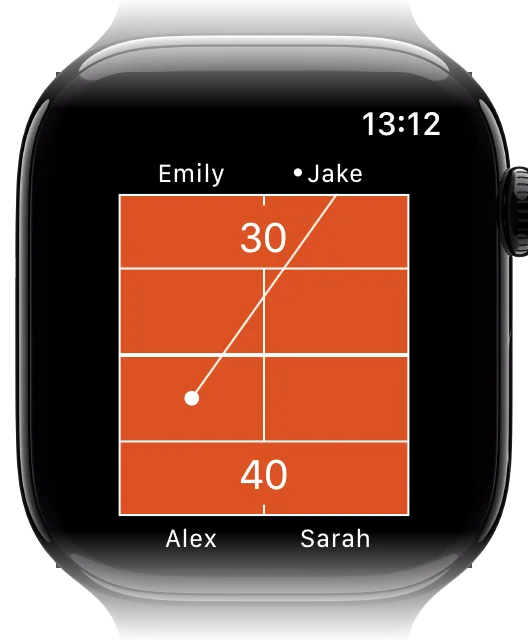
Court view 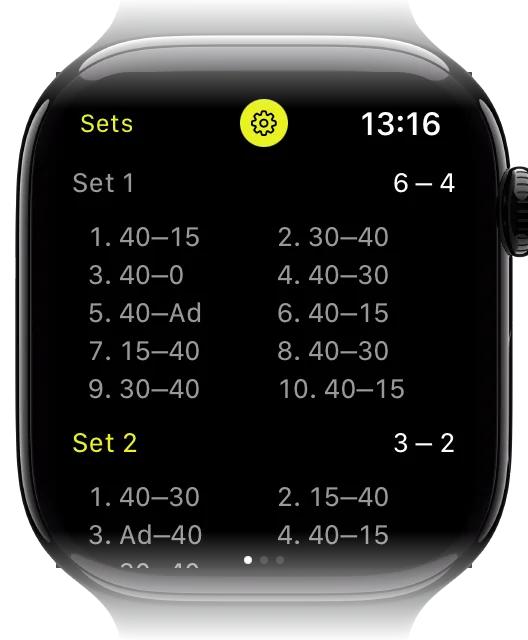
Sets 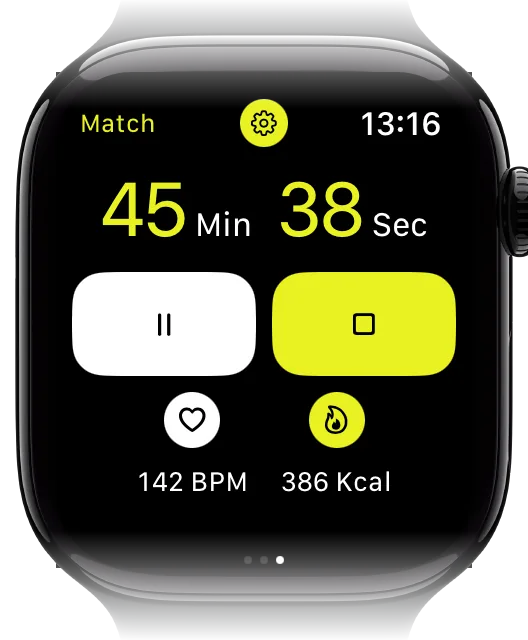
Workout 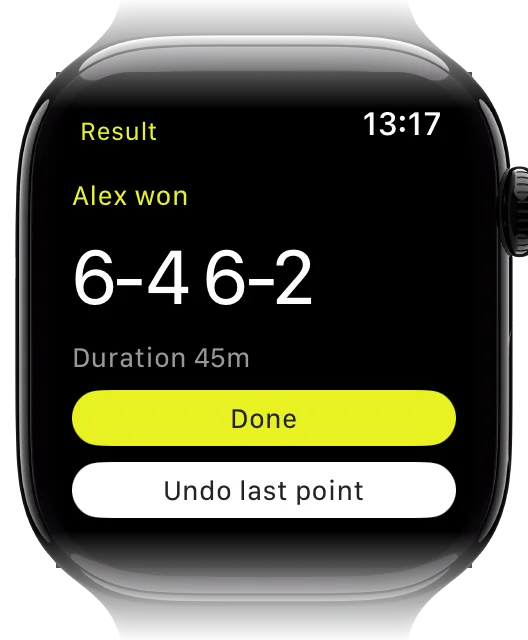
Result 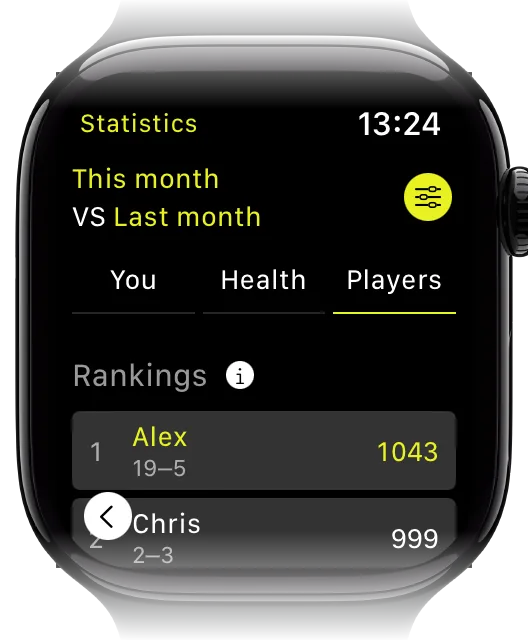
Rankings 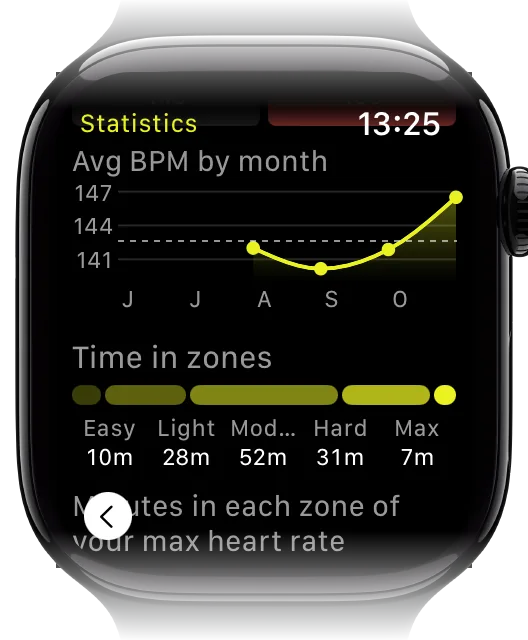
Heart-rate zones 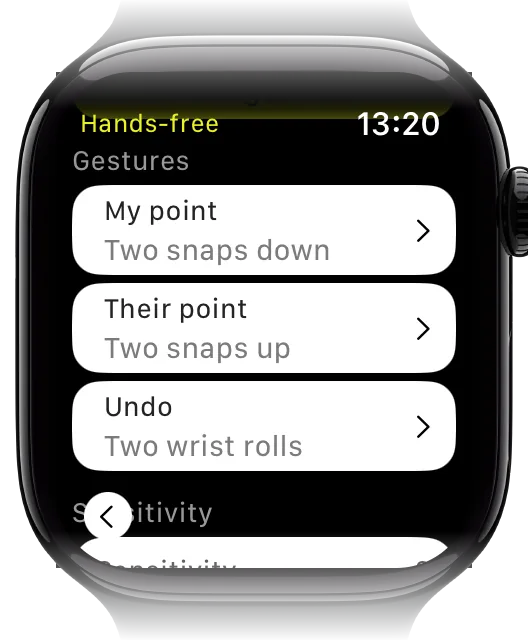
Gestures 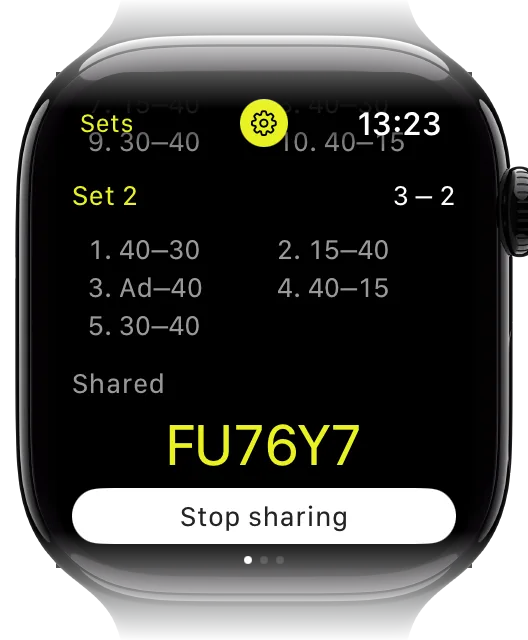
Share a match
iPhone
The phone tells the story afterwards
It scores a match on its own, mirrors the watch live, and turns history into rankings, head-to-heads and a rating that moves after every match.
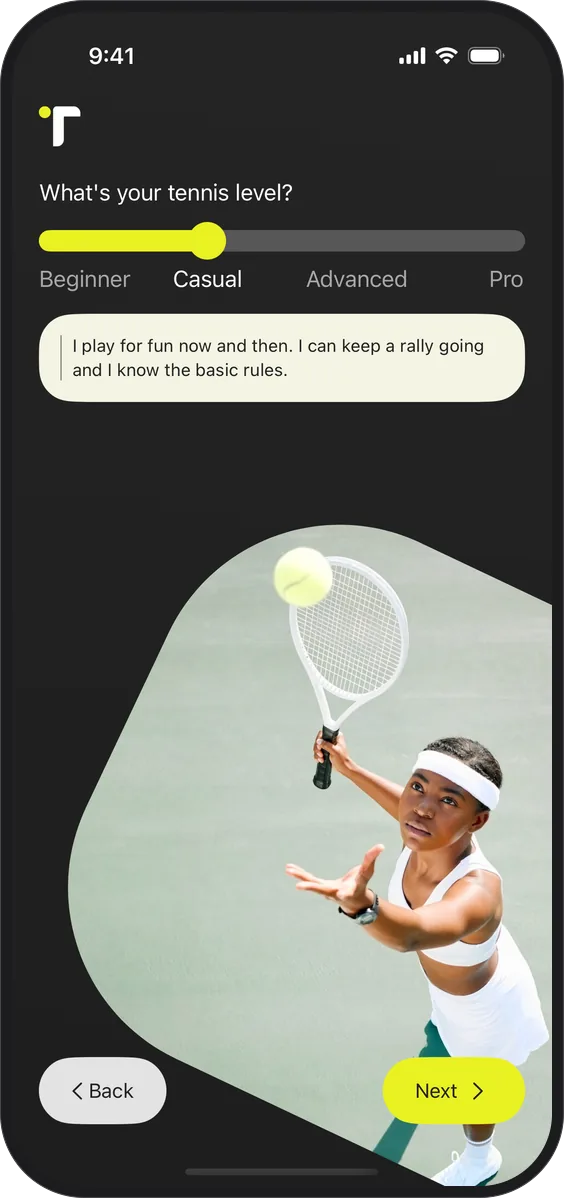
Onboarding 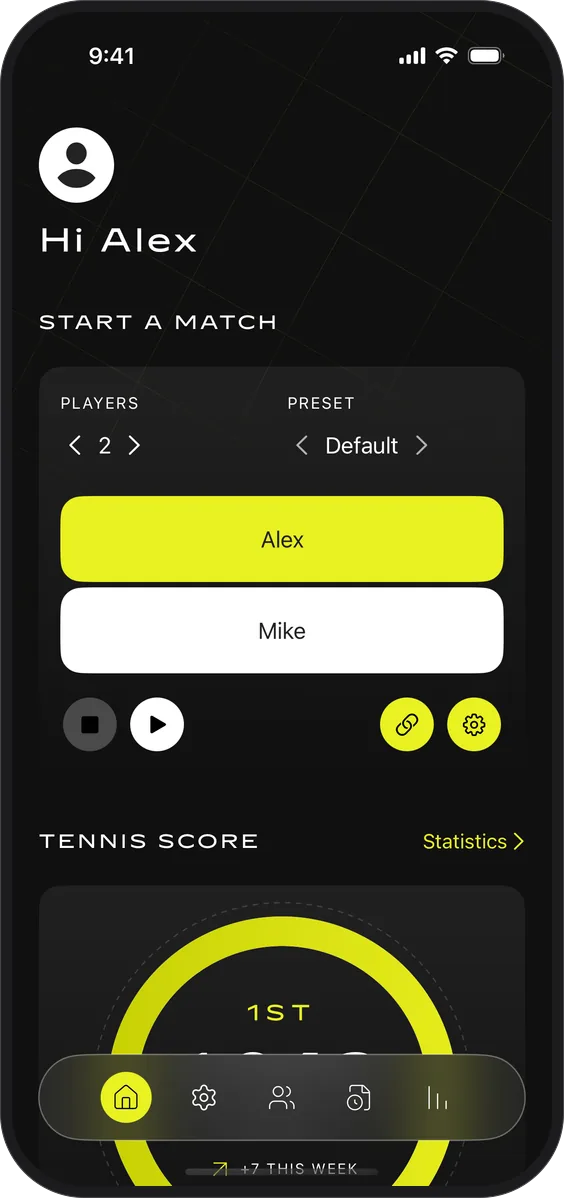
Home 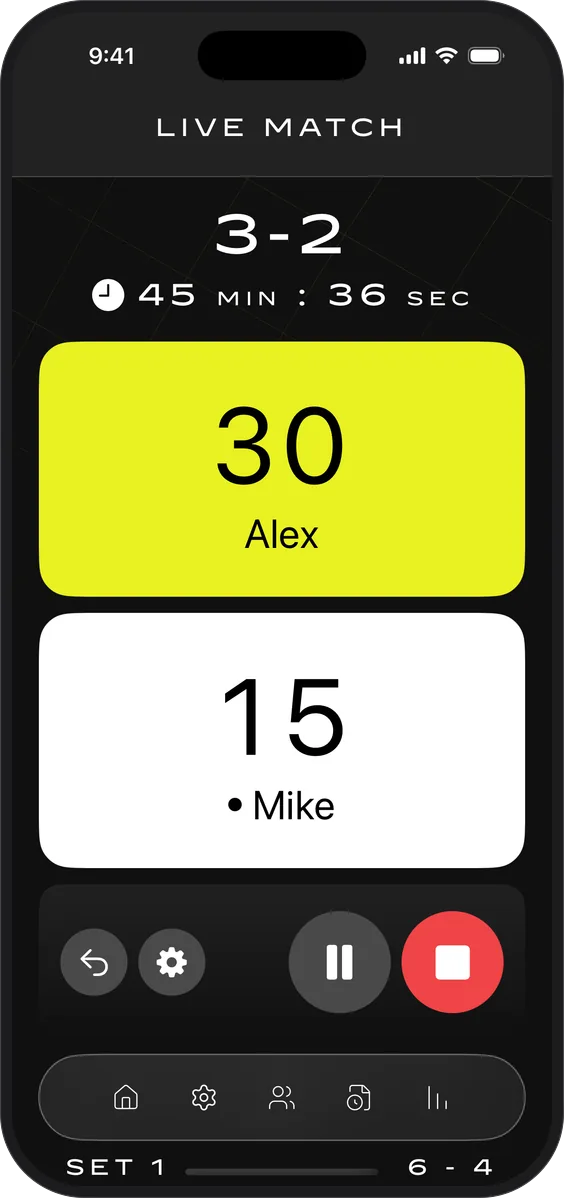
Live match 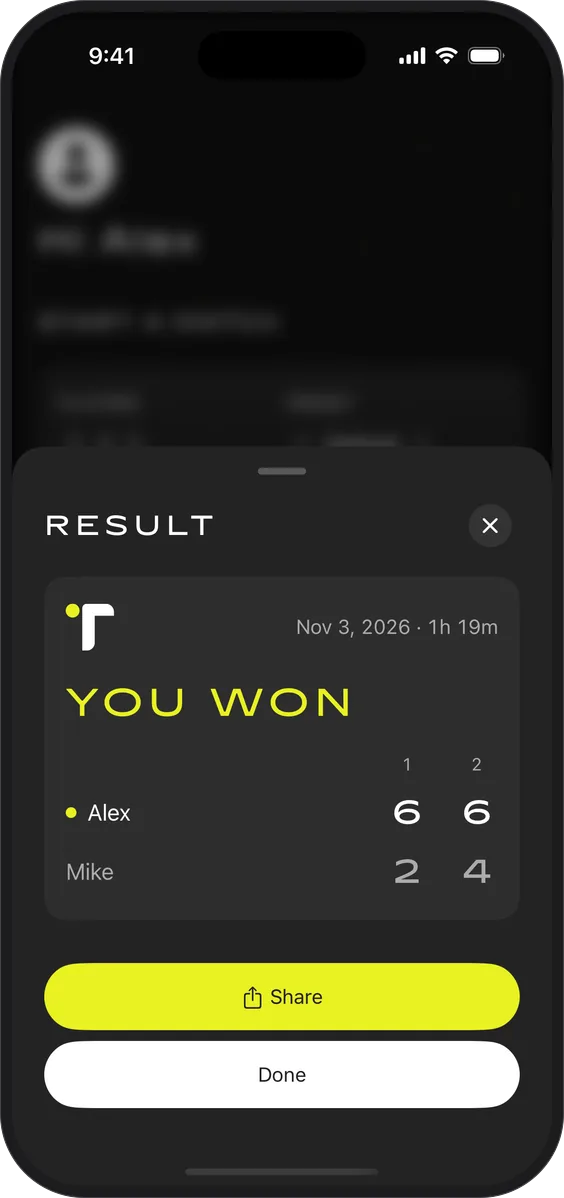
Result 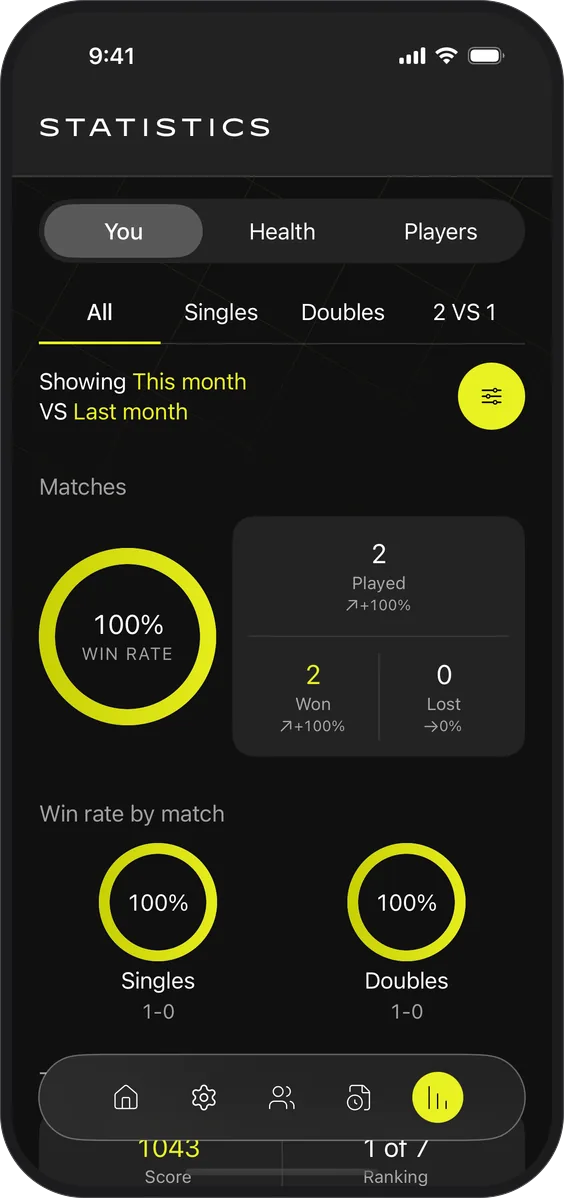
Statistics 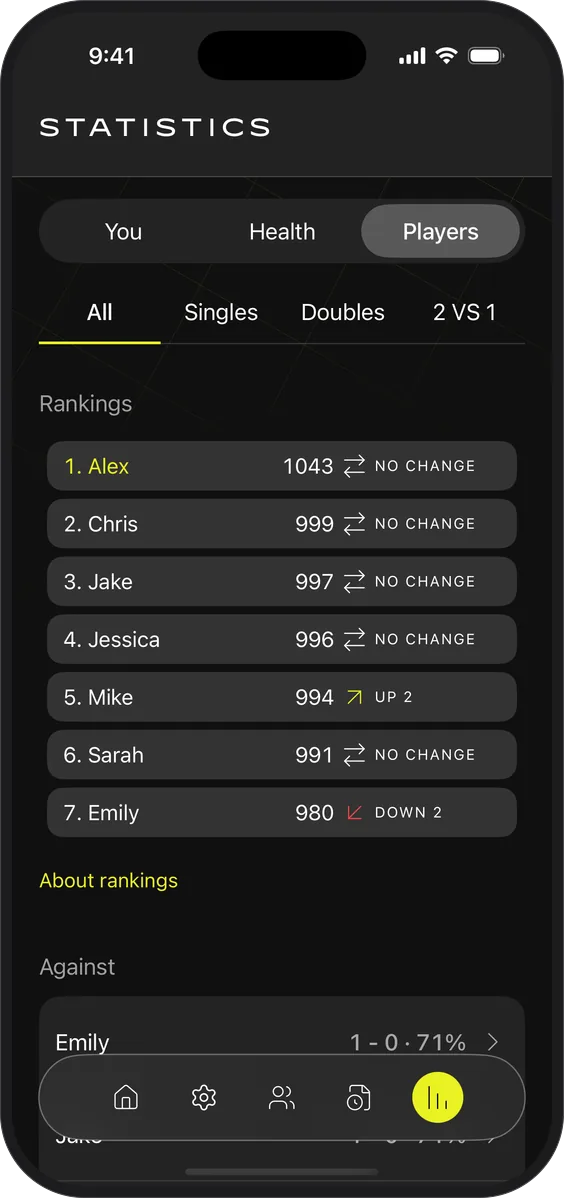
Players 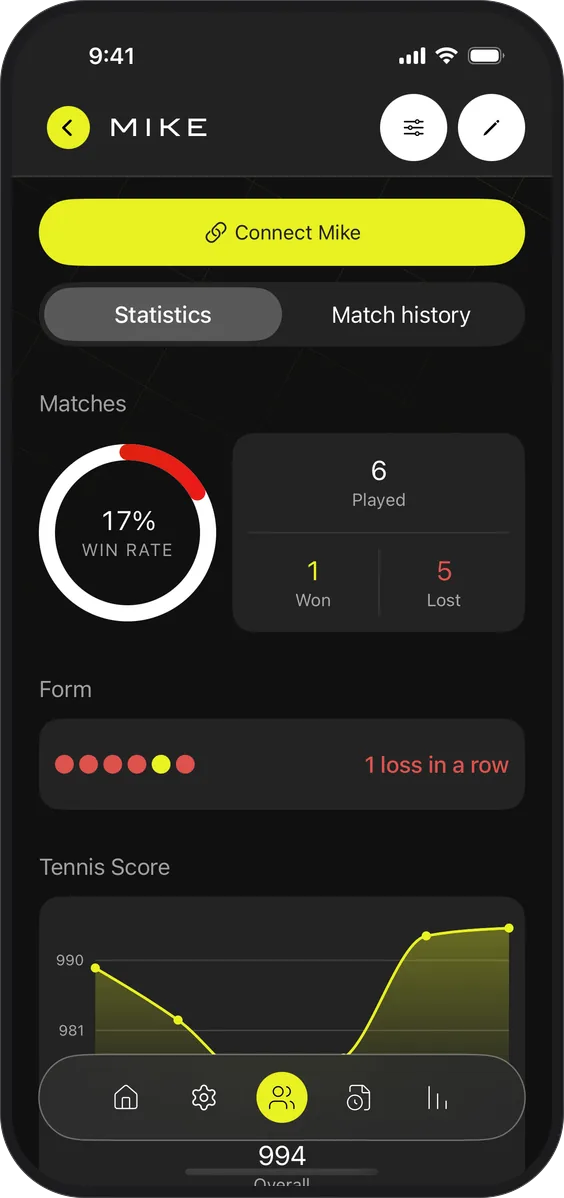
Player page 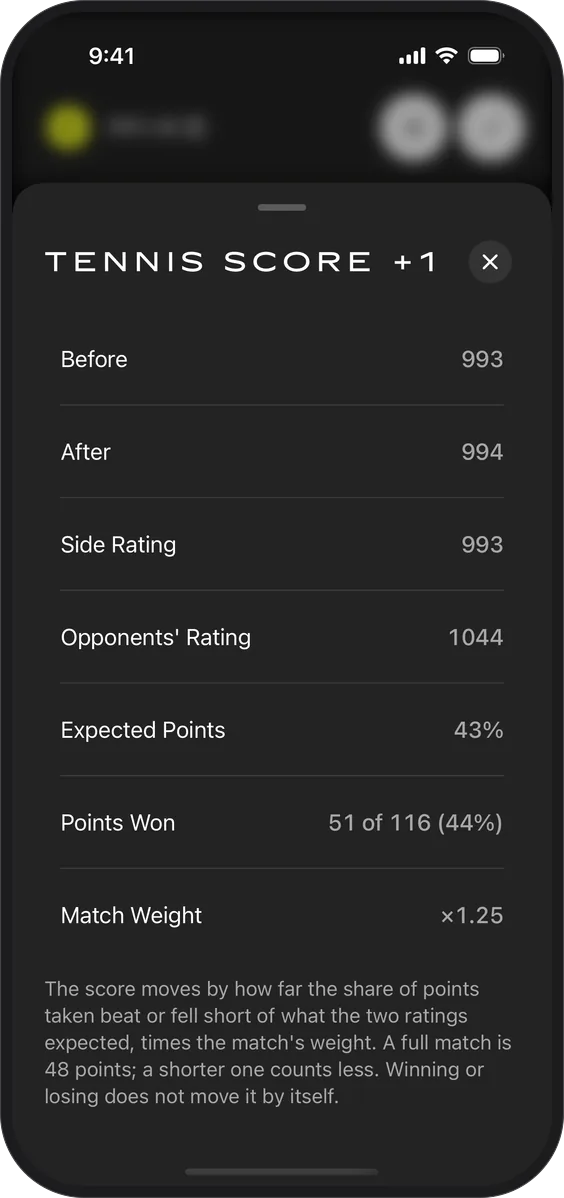
Rating explained 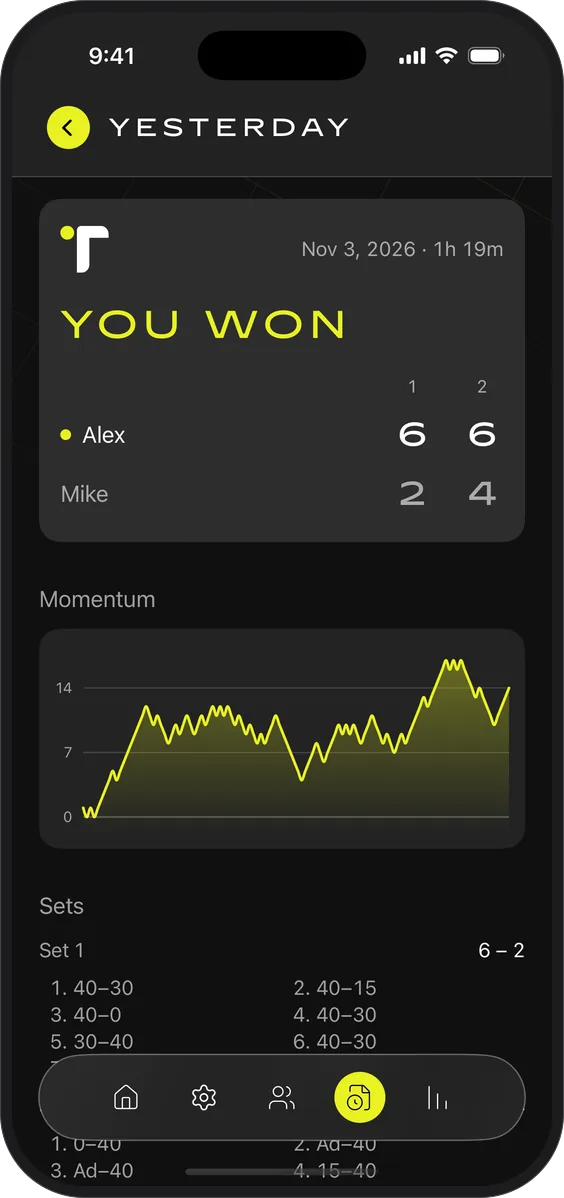
Match report 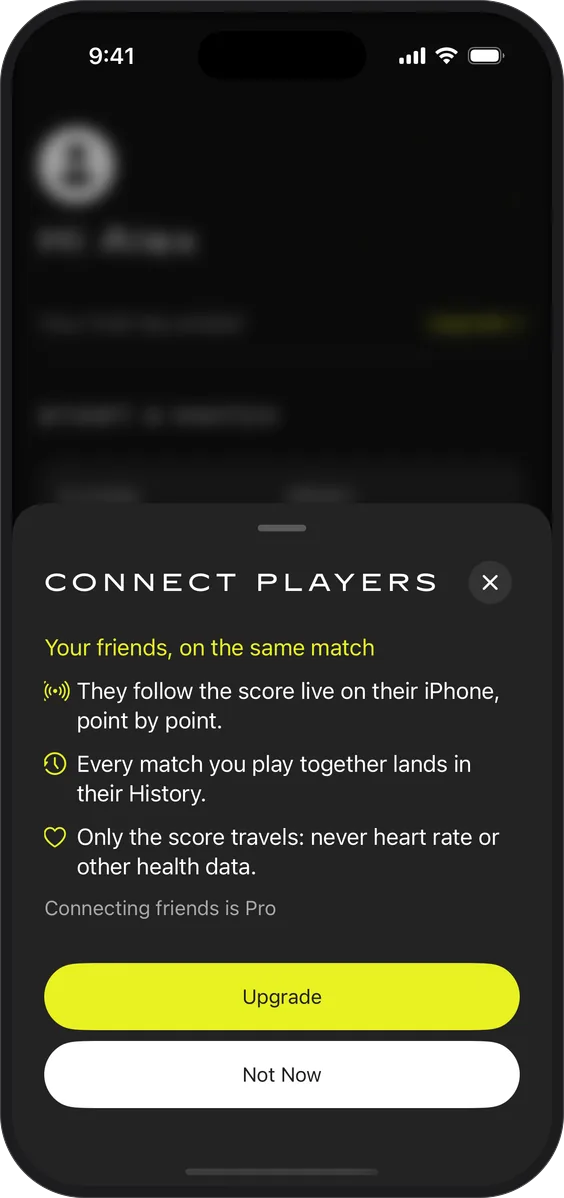
Connect a friend 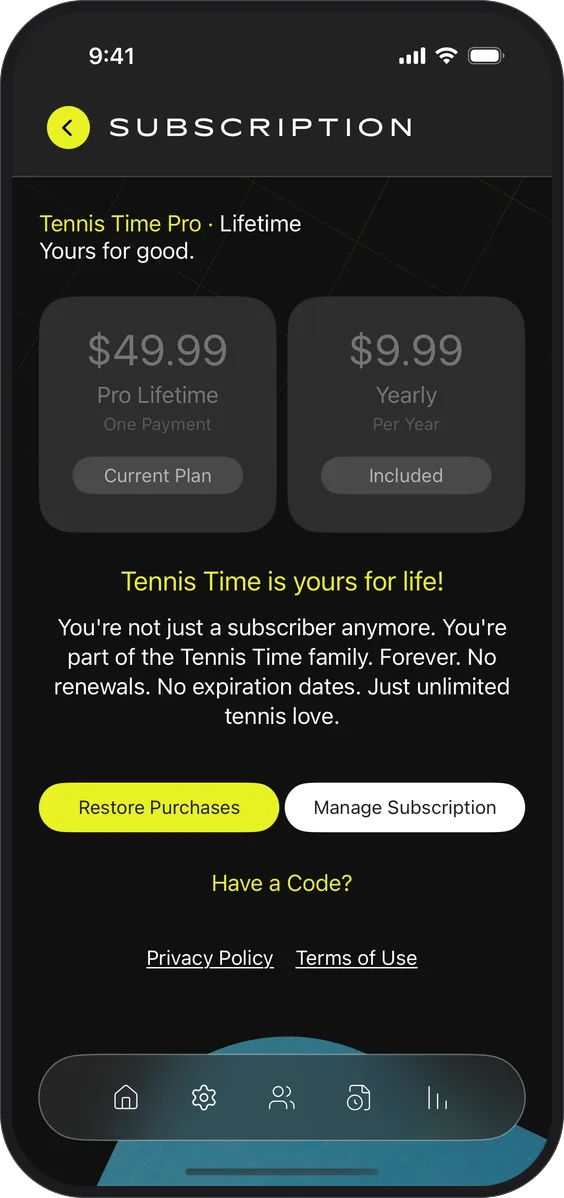
Plans
Design system
One system for a 45 mm screen and a 6.9 inch one
Colour, type, spacing, radius, size and motion are tokens in a shared Swift package. The project rule is strict: no literal value appears outside the token files. Both apps draw from the same 109 components.
brand#E9F122Your side, primary actionssurface#FFFFFFOpponent card, buttonssurfaceScreen#101010Every phone screensurfaceGroup#232323Grouped rowssurfaceMuted#333333Stat tilescourt#DB5224Court overlaywarning#EF4446Stop, destructive
- Display type
- PP Watch, uppercase and tracked
- Body type
- SF Compact on watch, SF Pro on phone, with Dynamic Type
- Spacing
- 2, 4, 8, 12, 16, 20, 24
- Press feedback
- Scale to 0.96, never fades
- Point change
- Rolling digit, 0.35 s ease-out
- Reduce Motion
- Every animation has a fade fallback
- Right-to-left
- Layouts mirror, the court and score cards stay physical
Architecture
No server, no account, no third-party code
The app is four Swift packages and two thin apps. TennisCore holds the rules and nothing else. It is pure Swift with no interface, which makes every scoring rule testable in isolation.
There is no backend to run. Matches sync through each user's private iCloud database. Shared matches and friend connections use the public database. Health figures never leave the user's own devices.
I ran the build as a product owner directing AI coding agents: a written spec, a plan, the implementation, then an independent review, for every feature. That produced 10 specs, 11 plans and 340 pull requests in under six weeks.
- TennisCore
- Models and the scoring engine
- TennisData
- SwiftData and CloudKit services
- TennisDesign
- Tokens and 109 components
- Code
- 49,500 lines of Swift, 21,300 lines of tests
What is next
What I would do next
Watch-face complications and a spoken score are on the roadmap and not built yet. A padel version is the obvious sibling, because the engine already separates rules from interface.
The open product question is the shared league: a ranking that a whole club can see. It needs a decision about identity that the no-account rule has so far avoided.